
A personal note in online form
Undo / No undo
5 October 2026 • Notoms
Two ways of making music have been running side by side lately, and they could hardly be further apart. One is slow, patient and endlessly reversible.
The other happens once, in front of people, and then it’s gone.
Undo: ambient with Eurorack/Oneiroi and Ableton
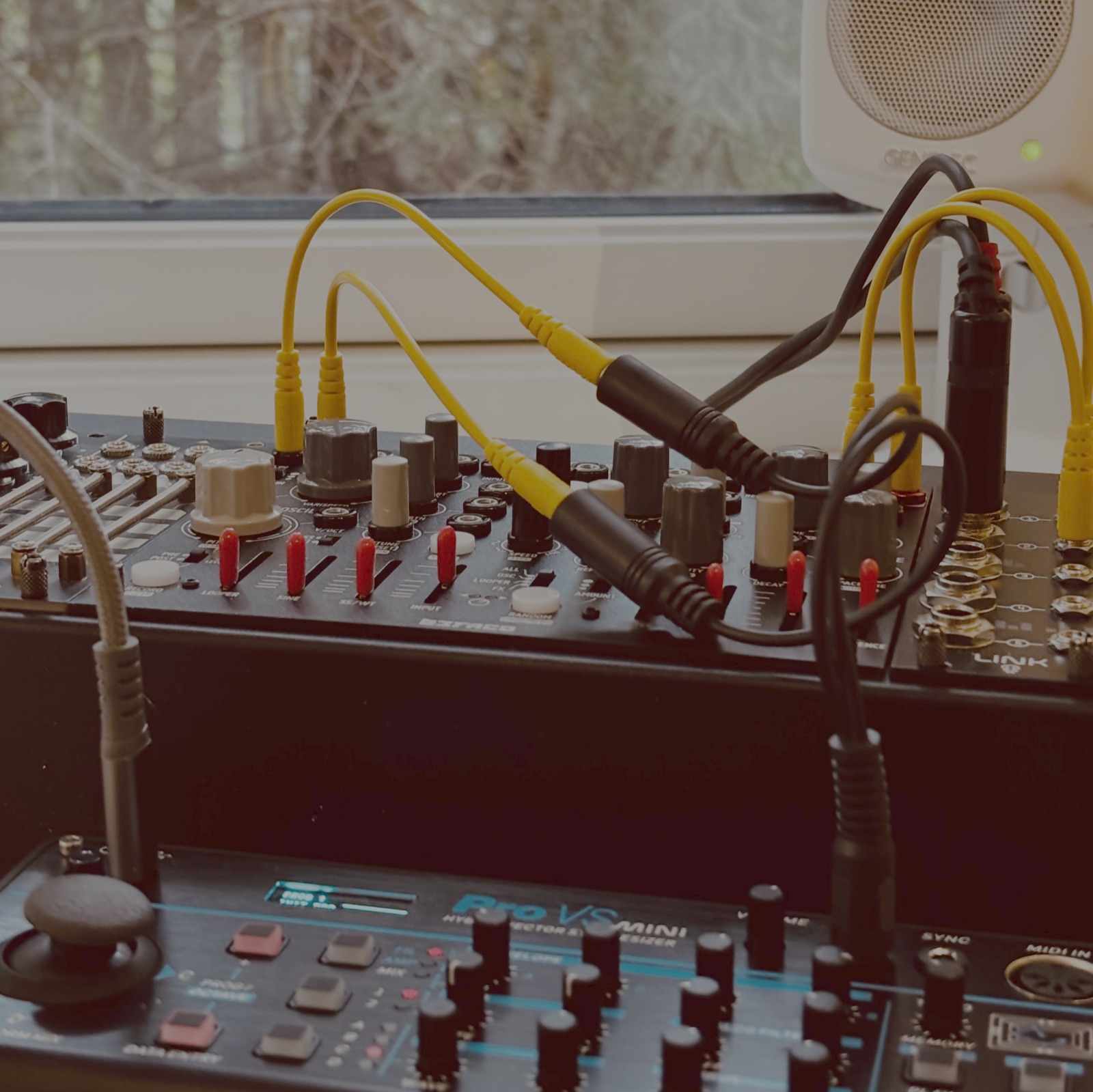
The ambient side starts in the Eurorack case, with the Befaco Oneiroi as an effect processor for synth doodling (Pro VS Mini synth), samples, voice recordings or the Oneiroi internal oscillator. It’s a whole small ambient instrument in one — and it’s good at producing sound that drifts, cascades and stays stationary at the same time.
But it sat in its box on my shelf for a good week or two. No energy to get into it and the all-too-familiar feeling of having bought something new instead of trying to do more with what I have already. But as I’m getting more into it, it really does hold something tactile and ethereal, reminding me of the earlier Eurorack days with Mutable Clouds, Elements, 2hp loop.
It builds on a listening experience. Just get lost in it, almost meditative, do small adjustments and see where it takes you. And the combination of subtle, tactile hardware changes and a healthy dose of Valhalla Futureverb brings even small mundane sounds into epic spaces.
There are endless possibilities on tap, to re-do, undo, try different variations of sound sources mixed together. Like sketching, drawing on new lines and strengthening those there to stay.
No undo: guitar gig in a work band

The other side is playing guitar in the work band, live — most recently on 17 September, at a venue in downtown Oslo, in front of somewhere between 100 and 150 colleagues. Here the rules are reversed. The songs are practiced in advance, the parts are as good as they’re going to get, and on the night you play what you have. Pulse rising, far from meditative.
We arrived around 13:00 to get a feel for the room. It looked good — a proper stage, high ceilings. Then the sound guy arrived, and the afternoon turned into cabling. Everything had to be set up from scratch: several lines to the drums, one for guitar, keys, bass, two vocals, and every monitor connected back to the central mixer. Two bands were playing, so there was changeover to plan for as well. I helped out with cables as best I could, and somewhere in the middle of it I started thinking about how much a stage actually is. All the pieces that have to come together before a single good sound reaches anyone.
My rig was deliberately simple: a ToneX pedal into a small DI box, a dirt pedal as a volume boost for solos, no amp. Same setup for rehearsals and the gig. The last decision was monitoring — floor wedge or in-ears. I went with in-ears, mostly because it’s easier to adjust my own level as needed.
And the in-ears were great. A very direct, clear representation of my own playing. It felt more pro than any gig I’ve done. The band’s stage mix was fine too; everyone on stage could hear the guitar.
The problem was that nobody else could. Out front, through the main speakers, the guitar was badly lacking. People in the room were waving up at me to turn up, and I couldn’t fix it from where I was standing — on stage, it all sounded right. The in-ears had given me a small private studio on stage, with a perfect mix of my own playing. That was exactly what hid the problem.
Aagh.
It’s probably not that the guitar was gone entirely — more that it was too weak in the main mix. But I’d spent a lot of time preparing the songs and the solos, and knowing that most of it didn’t reach the room zaps the joy of playing (obviously).
I’ve wondered whether the direct setup was part of it. A real amp and cabinet have a more nasal, mid-heavy bite that cuts through a band mix. A cabinet simulation straight to the desk is cleaner, more hi-fi — and possibly easier to bury under drums, bass and keys.
There is no second take. It’s a very immediate kind of feeling — butterflies, focus, and over all too quickly. Whatever reached the room is what happened.
Takeaways
- Sound is always the weak spot. A room full of talking, cheering people sounds nothing like the rehearsal space, and the mix that worked at soundcheck doesn’t survive the crowd. Whoever is behind the desk is hearing it for the first time too.
- In-ears tell you what you hear, not what the room hears. They’re great for playing, and useless for judging the front-of-house mix. Next time someone needs to stand out front during the first song and report back — or I walk out there myself at soundcheck.
- Start with something loose. Open with a bit of improv, or just a groove going, before the first real song. A few minutes to check that every instrument is actually audible in the room — a small window of undo before the no-undo part begins.
- Give the direct guitar more mids. If I stay with the ToneX and DI, the tone needs to be shaped to cut through a full band in a live room, not to sound nice on its own in headphones.
Between the two
The two halves seem to need each other. Endless tweaking makes it good to have something where the answer is simply this is it. And the pressure of the gig makes it good to come home to a patch that doesn’t care whether you get it right.
One gives time to find things. The other forces you to commit to them.